









What is Stake Dice?
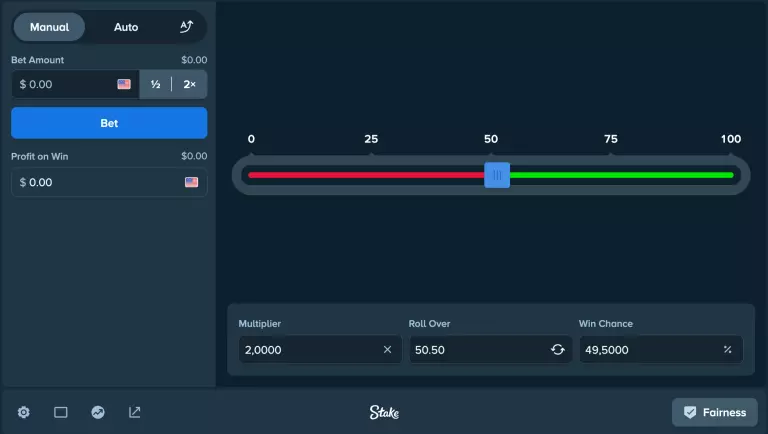
Stake Dice is a Stake Originals title - built in-house, available exclusively on the site, and unlike anything you'd find in a traditional casino or free-to-play slots library.
The mechanic is simple: a random-number generator simulates a 100-sided die, and you predict whether the result will land above or below a number you set. There are no reels, no bonus rounds, no waiting for animations to resolve.
Every round is one roll, one call, one outcome. That makes Dice one of the fastest games on the site - you can complete dozens of rounds in the time it takes a single slot spin sequence to finish.
How to play Stake Dice
Getting started takes less than a minute. Here's the full process from the lobby to your first roll.
- Find the game: Open the Stake Originals menu from the main lobby, or type "dice" into the search bar.
- Choose your currency: Select Gold Coins (GC) for casual play or Stake Cash (SC) if you're working toward the playthrough requirement for redemption.
- Set your play amount: Enter how much GC or SC you want to put on each round.
- Adjust the slider: Drag the slider to your target number (anywhere between 0 and 100) and choose whether you're predicting Over or Under that number.
- Roll: Click the Roll button or press Space on your keyboard to trigger the round.
- Collect your payout: If the roll matches your prediction, your return is the play amount multiplied by the multiplier shown on screen before you rolled.
The over/under mechanic explained
The slider is where all the interesting decisions happen in Stake Dice. Shifting it left or right changes both your odds of winning and the multiplier you earn if you do.
Set it to "Over 50" and you win whenever the roll lands on 51 or higher - that's roughly a 49% chance, with a multiplier around 2x. Move it to "Under 10" and the target narrows sharply: you only win on a result of 9 or lower, giving you about a 9% chance at a ~10x multiplier.
This inverse relationship is the core design of the game. A higher potential payout always comes with a lower probability of winning - and vice versa.
There's no setting that beats the house; the RTP stays consistent across the slider, so the choice is purely about how much variance you can tolerate.
Stake Dice payout table (example values)
The figures below are illustrative examples to show how the relationship between win chance and multiplier works. The exact multiplier updates live on the slider as you move it, so treat these as a guide rather than fixed values.
| Prediction | Win chance | Typical multiplier |
|---|---|---|
| Over 50 | ~49% | ~2.0x |
| Over 25 | ~74% | ~1.33x |
| Under 25 | ~24% | ~4.0x |
| Under 10 | ~9% | ~10x |
| Under 2 | ~2% | ~50x |
Stake Dice RTP
RTP - return to player - is the percentage of total play amounts a game returns to players over a large number of rounds. For Stake Dice, that figure reaches up to 99%.
In practical terms: for every 100 SC played over a long session, an average of 99 SC is returned. Your balance depletes slowly rather than sharply.
Compare that to typical slots, which usually run at 96-97% RTP. Over a session of the same length, Dice costs you less in expected losses.
That's a meaningful difference when your goal is to complete the Stake.us sweepstakes playthrough requirement without burning through your SC balance.
Stake.us Bonus Offers:
Dice strategy: the classic "Martingale" trap
High RTP attracts players who want to use a system, and the most common one you'll hear about for Dice is the Martingale - double your play amount after every loss until you win back your losses in one hit.
The appeal is obvious: if you eventually win, you recover everything. But losing streaks arrive faster than most players expect.
At the 50/50 setting, eight consecutive losses - a roughly 0.4% probability on any given sequence - requires you to play 256x your original amount just to break even. That can mean wiping a 100 SC balance in a handful of rounds.
Dice's high RTP is a genuine advantage for conservative play. It is not a guarantee that systems work.
The house edge exists on every single roll, regardless of what happened on the roll before it.
Real-life example: 100 SC session on Stake Dice
Numbers make the RTP concept easier to picture. Here's how a straightforward 100-round session might look.
Start with 100 SC. Play 1 SC per round at the "Over 50" setting (~2x multiplier).
After 100 rounds at 99% RTP, your expected balance is roughly 99 SC - you've played 100 SC worth of rounds and returned about 99 SC in winnings. But here's the useful part: those 100 rounds generated 100 SC of playthrough.
Play the same session three times and you've produced 300 SC of playthrough on a starting 100 SC balance, because the game returns so much of what you put through it. That slow, grinding efficiency is exactly why Dice is one of the best games on the site for SC playthrough.
You can read more about how this fits into the broader Stake.us picture in our full Stake.us review.
Autoplay and hotkeys
Stake Dice includes several controls that speed up play or let you set automated sequences. Here's what's available.
- Manual play - click Roll or press Space for each individual round.
- Autoplay - set a fixed number of rounds to run automatically, with optional stop-on-profit and stop-on-loss triggers to keep sessions within limits.
- On-win / on-loss actions - configure autoplay to increase or reset the play amount depending on the result of each round. Use this carefully - this is the mechanic that enables Martingale-style systems, and the risks are real.
- Hotkeys - keyboard shortcuts cover rolling, adjusting the play amount, and quick resets, useful for fast-paced sessions.
Provably fair verification
Stake Dice is built on a provably fair system, which means you don't have to take the site's word for it that the RNG is honest. Every roll can be independently verified.
Each round is generated from three inputs: a server seed, a client seed, and a nonce. The server seed is committed before you play - it's hashed and published in advance so the site can't change it after seeing your prediction.
After the round, you can open the Fairness tab and check that the roll matches the seed combination.
This level of transparency isn't available on most sweepstakes casinos. It puts Stake Dice in a different category from standard RNG slots, where you have no way to independently confirm the result.
Dice pros and cons
Here's a quick summary of where Stake Dice excels and where it has limits - useful context before you decide how to use it in your sessions.
- Up to 99% RTP - among the highest anywhere
- Simple to learn - one decision per round
- Very fast tempo
- Adjustable risk via the slider
- Provably fair - every roll verifiable
- Great for playthrough on SC
- Very high variance at low win-chance settings
- Autoplay + Martingale can wipe balances fast
- Small win amounts at safe settings can feel slow
Other Stake Originals to try
If you enjoy the clean, fast-decision format of Dice, several other Stake Originals follow a similar design logic - one choice, one outcome, adjustable risk. These three are worth exploring next.
🎯 Plinko
Plinko drops a ball down a peg board and lets it bounce unpredictably into a multiplier slot at the bottom. You control the number of rows and the risk level, which shifts the distribution of outcomes between frequent small wins and rare big ones.
🃏 Hi-Lo
Hi-Lo asks you to predict whether the next card drawn is higher or lower than the current one. Each correct call builds the multiplier, and you choose when to cash out - or risk another card.
🐔 Chicken
Chicken puts a bird on a busy road and challenges you to guide it across as many lanes as possible before cashing out. Each lane survived increases your multiplier; stay too long and you lose it all.
Stake.us welcome bonus
New players at Stake.us receive 25,000 GC and 25 SC just for signing up - no purchase required. Thanks to Dice's 99% RTP, that 25 SC goes further here than on almost any other game on the site; you can generate far more playthrough per SC than you would on slots, because so little is lost on each round.
Stake.us is open to players aged 21 and over in eligible US states. If that's you, the sign-up bonus gives you a meaningful amount to work with from day one - and Dice is one of the smartest places to put it to work.
Check the Stake.us free spins and best slots pages if you want to explore other options alongside Dice.
| Bonus | Amount | Requirement |
|---|---|---|
| Gold Coins | 25,000 GC | No purchase, sign-up only |
| Stake Cash | 25 SC | No purchase, sign-up only |
| Playthrough | 3x on SC | Before redemption |
| Age / location | 21+ in eligible state | KYC required |

Other Stake.us guides
Stake Dice is one part of a much larger site. These guides cover everything else you might want to know about Stake.us - from bonuses to individual games to how the sweepstakes model works.
Conclusion
Stake Dice earns its reputation as a player-friendly game through sheer simplicity and a 99% RTP that makes your SC balance last longer than almost anything else on the site. One decision, one roll, one outcome - there's nothing to learn except where to set the slider.
If your priority is efficient SC playthrough with minimal complexity, Dice is a strong starting point. Pair it with the no-purchase sign-up bonus, keep your play amounts steady, and avoid the autoplay traps - and you have one of the most rational ways to play on any social casino available to US players today.
FAQs
Is Stake Dice really 99% RTP?
Yes - Stake Dice is designed to return up to 99% of play amounts over a large sample of rounds. That figure applies across the slider range, so the RTP doesn't change depending on whether you play Over 50 or Under 10. What changes is variance: low-probability settings pay more per win but hit less often.
Can I play Stake Dice for free?
Yes. When you sign up at Stake.us you receive 25,000 GC and 25 SC at no cost. You can play Dice using Gold Coins at any time without spending anything. Gold Coin play is purely for fun and carries no redemption value; Stake Cash play counts toward the 3x playthrough needed before you can redeem for cash prizes.
Is a betting strategy like Martingale worth using on Dice?
Not in any reliable sense. Martingale and similar doubling systems look appealing because they eventually produce a winning round - but a short losing streak at 50/50 odds can require hundreds of times your starting amount to recover. Dice's high RTP is best used through consistent, flat play amounts rather than escalating systems that risk wiping your balance in a few rounds.