





Understanding Polymarket prices
Prediction markets have become one of the fastest growing sectors online, and right at the forefront of this is Polymarket. Prediction market platforms like Polymarket allow users to buy, sell, and trade event contracts tied to real world events, from whether there will be a pandemic this year to what an announcer might say at the next televised NFL game. This guide looks at one of the key elements involved in this experience - prices, and we’ll take you through the whole process so you know which factors affect prices and can make informed decisions accordingly.
As mentioned in our full Polymarket review, every prediction market revolves around prices that constantly move according to user opinion, new information, and the number of event contracts available (liquidity).Understanding how these prices are arrived at and what that might mean is essential to the whole Polymarket process.
What do Polymarket prices mean?
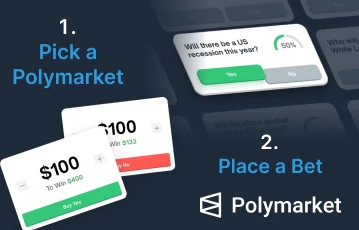
Most Polymarket event contracts use two sides, Yes and No, and are tied to a real-world question, like ‘Will it rain today in X location’. On Polymarket, every prediction market is priced between $0.01 and $0.99. Price translates to probability, so the price is an estimated probability that an event will happen, so for example:
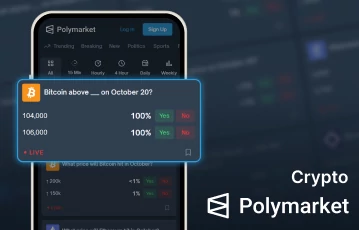
- If you see the ‘Yes’ contract for Bitcoin price rising in the next 15 mins at $0.25, that means the market believes that outcome has a 25% chance.
- A $0.55 price for Spain to win the FIFA World Cup means the contract is trading at a price that implies roughly a 55% probability.
- A $0.43 price for Elon Musk to become a trillionaire this year implies a 43% probability.
If any of these predictions are correct, the contract settles at $1 per share (see our Polymarket fees explained guide for a full breakdown of trading costs). If the outcome is incorrect, the contract settles at $0. So, if you bought 10 contracts for our Bitcoin example above, you would pay $2.50 upfront. If the prediction was correct, those contracts would settle for $10, giving you a $7.50 profit before any applicable fees. If the prediction was wrong, the contracts would settle at $0 and you would lose the amount you paid.
Polymarket prices pros and cons
- Plenty of markets to choose from
- Simple contract buying process
- Wide platform availability
- Might seem confusing to newbies
How are Polymarket prices calculated?
The prices are not really set, but shaped by opinion as well as supply and demand. Every user at Polymarket can buy and sell contracts and this behaviour shapes the prices you see when you look at any prediction market. If more users believe an event is likely to happen, the demand for ‘yes’ contracts grows along with the price. The opposite happens if users believe an event is unlikely to happen. This means that prices at Polymarket are essentially user generated rather than set by anybody at Polymarket, and that means they can move, sometimes rapidly as opinion changes.
Example: Will the BitCoin price by X amount this week?
‘Yes’ contracts for this market start at $0.42 on Monday, with ‘No’ contracts priced at $0.58. This implies that users believe the outcome has about a 42% chance of happening, and a 58% that the Yes outcome does not happen. Now imagine breaking news that a major online retailer was now accepting BTC as payment, and following that news more users buy ‘Yes’ contracts, increasing the price. The same market on Wednesday might look more like Yes - $0.72, no - $0.28, and means that prices have moved drastically in a short space of time. In short, any $0.42 contracts you bought are now trading at $0.72.
Why Polymarket prices move
That was just one example of a price movement, but there are multiple factors that can affect the prices of any predictions linked to real world events. Some other examples might be:
| Factor affecting Polymarket prices | Potential effect |
|---|---|
| Breaking news | Rapid change due to unexpected event |
| Polling data | Recent surveys can affect Polymarket election markets |
| Injury reports | Star player absence can affect the outcome of sporting events |
| Social media trends | Public perception of an actor could affect their chances of winning an award |
| Weather updates | High winds or rain could affect the outcome of sporting events |
With the large number of users in any given market, reaction to news can often be quick and this is why the movement in Polymarket prices can be very useful if you want to trade event contracts.
Why some users sell before a market resolves
This is a practice you might have seen elsewhere, for instance with stock trading. While the mechanics trading on Polymarket are slightly different the principle is very similar. The idea is to buy contracts at one price, and sell for a greater price to make a profit. This means users don’t just buy their contracts and wait until the market resolves, instead they can sell strategically to
- Lock in a profit
- Mitigate a loss
This can be done across any number of markets, from Polymarket sports markets to crypto and business. The best way of illustrating this is with another example:
Going back to the hypothetical Bitcoin market we used earlier, where you bought ‘Yes’ contracts on a price rise at $0.42, and the breaking news sent the price soaring to $0.72. You could hold onto those contracts, hoping that the news will keep things high until the end of the week, or you can sell now for a profit. This removes your exposure to any uncertainty during the remaining days of the market timeframe where more breaking news could still send the price falling like a stone. Yes, you wouldn’t realise the full $1 per contract if things stayed the way they were, but you are not running any further risk.
On the other hand if you had bought those ‘Yes’ contracts at $0.42 and the price started to drop, you might choose to sell to reduce the amount you could lose rather than wait to see if the market picks up before the deadline. So in this case, if the price dropped to $0.28 per contract and you sold, you would only have a loss of $0.14 per contract, instead of potentially ending up with nothing.
The role emotions can play in affecting Polymarket prices
This brings us on to another key element that affects Polymarket prices - psychology. It’s not all about the maths, it’s also about emotions as well. If you tend to be more cautious, you may judge the situation differently to somebody with a more optimistic outlook. This means prices can sometimes become slightly disconnected from objective reality. Popular figures or viral news can create temporary spikes in prices, as well as what users might read on social media.
Conclusion - your one stop guide to Polymarket prices
At first glance Polymarket prices might seem a little hard to work out, but after reading this guide you’ll know not only how those prices are decided, but also what factors drive any changes. That allows you to decide on your strategy when you approach prediction markets, and whether you buy and hold or trade out when it is advantageous to you. With all of the confusion out of the way, you can get started whenever you feel ready, with the links on this page taking you straight to Polymarket. You can also use a Polymarket referral code, if you have one.
Polymarket prices FAQs
What do Polymarket prices mean?
In prediction markets, any event has a probability, and that translates to a price. For example, if the market believes that there is a 52% chance it will rain today in NYC, then the event contracts for that outcome will be priced at $0.52. This price can change as market opinion changes, so there is the potential to trade.
What affects Polymarket prices?
Polymarket predictions are tied to real world events, so any factor associated with those events can affect the price. For instance the market for the cost of gas might be affected by a political speech or conflict.
Can you sell event contracts at Polymarket?
Yes. Once you have bought your event contracts, you can sell them if the market moves in your favor for a profit, or in less fortunate circumstances to mitigate a loss. Any profits can be affected by commission, so take this into account when you make any selling decision.