




What are Polymarket election markets and how do they work?
Before we dive in, here is a quick overview of the basics to know about Polymarket:
| Feature | Details |
|---|---|
| Market Coverage | Elections from countries around the world. |
| Market Types | Presidential elections, parliamentary elections, party nominees, mayoral races, referendums, and other political events. |
| Contract Format | Simple Yes/No binary contracts based on a defined outcome. |
| Contract Pricing | Contracts typically trade between $0.01 and $0.99, reflecting the market's implied probability. |
| Settlement | Winning contracts settle at $1.00 per share, while losing contracts settle at $0. |
| Trading Activity | Prices and trading volume update continuously as participants buy and sell contracts. |
| Market Activity | Prices and trading volume update continuously. |
| Market Access | Live market prices are publicly viewable. |
| Example Markets | Presidential elections, parliamentary elections, party nominees, mayoral races, and referendums. |
A Polymarket election market is a contract built around a specific political question. Like the Polymarket sports market, every contract is a YES or NO position on one verifiable outcome. Either a specific candidate wins an election or they do not. Either a particular party takes a majority or they do not. You buy YES if you think it happens and NO if you think it does not.
Before you read our Polymarket fees guide, understand how Polymarket election markets work first. Think of each market as a simple Yes or No question. Each contract is typically priced between $0.01 and $0.99, and that price reflects the market's implied probability of an outcome. So, if a contract is priced at $0.72, the market is implying about a 72% chance that outcome happens. If that outcome resolves correctly, your contract pays out at $1 per share.
If it resolves against you, the contract settles at $0. You do not have to wait for resolution either. At any point before the market resolves, you can sell your position at the current market price, locking in the difference from where you bought.
Pros and cons of Polymarket election markets
- 59 active global election markets live
- $299.1M plus in verified trading volume
- Real-time update on every news development
- Covers elections on 6 continents
- USDC only for deposits and withdrawals
- Liquidity varies widely
What types of global election prediction markets can you trade on Polymarket?
Polymarket is not just about US elections. We went through the full elections section and found active markets from South Korea to Colombia to Spain to Cyprus all running at the same time. Here is what each category looks like:
US presidential and congressional markets
This is where the biggest volumes are. Markets like the Democratic Presidential Nominee 2028, the Republican Presidential Nominee 2028, and the Presidential Election Winner 2028 are already live and attracting traders even though the election is years away. During past US election cycles Polymarket also covered individual battleground states including Michigan, Pennsylvania, Wisconsin, Arizona, Georgia, North Carolina, and Nevada. Traders could take a position on which party wins each one.
UK and European parliamentary markets
European elections are very active on Polymarket. We found markets on the Cyprus House of Representatives, the President of Andalusia in Spain, the Venice Mayor in Italy, the Makerfield by-election in the UK, and the Next French Presidential Election all running simultaneously. We opened the Andalusia market and saw Juanma Moreno sitting at 99% implied probability. The Cyprus market had over $57,000 in trading volume behind it.
Latin American presidential markets
The Colombia Presidential Election was the single largest election market we found during our Polymarket review with $30 million in trading volume behind it. That level of trading volume shows how much attention the market attracted. Colombia attracted significant interest because several candidates remained competitive, keeping the market active as traders reacted to new information.
Margin of victory markets
Some markets do not just ask who wins. They ask by how much. The Makerfield by-election in the UK had separate markets asking whether Labour wins by more than 9% or between 6 and 9%. Malta had a market asking whether Labour wins its parliamentary election by 25 percent or more. These markets are for traders who follow polling detail closely and want to express a very specific view rather than just picking a winner.

How to get started with election markets on Polymarket
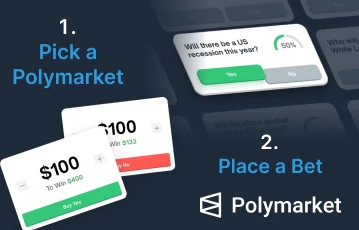
The steps are straightforward and we walked through every one of them. Use our on-page banners throughout to reach Polymarket directly.
- Use our On-Page banners to reach Polymarket: Click any of our on-page banners to head straight to the Polymarket sign-up page. You can also join through a Polymarket referral code shared by a friend, which takes you to the same registration process, if available.
- Create your account: Tap the Sign Up button at the top right of the Polymarket page. Enter your email address and follow the prompts. If you already have a crypto wallet, you can connect that instead of signing up with email. You can also continue with Google. Either way, the sign-up process usually takes just a few minutes.
- Verify your identity: Polymarket is a regulated platform in the US and it needs to confirm who you are before you can trade. Verify your account by uploading a government-issued photo ID like a passport or driving licence and the check usually clears within a few minutes. You cannot deposit or trade until this is done so get it out of the way first.
- Fund your account: You can fund your Polymarket account by purchasing USDC through an integrated payment provider using a debit card or bank transfer, or by transferring supported crypto from your own wallet. Depending on the deposit method, your funds may be converted into the collateral used for trading. Once the funds arrive, you're ready to start trading.
- Find the elections section: Click Politics at the top navigation bar then select Elections. A world map appears showing every country with an active election market highlighted. Scroll through the contract cards or use the month filter tabs to find an election you follow. Each card shows the candidates or outcomes and their current implied probabilities.
- Select a market and open a position: Click any election contract that interests you and place your trade. The market page shows the complete list of outcomes with current Polymarket prices, and the rules that govern how this market resolves. Read the resolution rules and place your trade by clicking Yes or No on your chosen outcome, entering the amount you want to commit, reviewing the number of shares, and confirming the trade. Your position appears in your portfolio immediately.
Final verdict on Polymarket election markets
Polymarket's election section covers political events from countries around the world, giving you access to everything from presidential elections and parliamentary races to party nominations and local contests. New markets appear as major elections approach, while active trading keeps prices moving as fresh information becomes available.
You don't need to place a trade to benefit from the insights these markets provide. But if you do want to back your political predictions, Polymarket's straightforward contract pricing makes it easy to see how the market is evaluating each possible outcome.
Use our on-page banners to visit Polymarket, create your account, and explore the latest election markets. Whether you're ready to trade or simply want to follow political events through market sentiment, there's always something worth trading.
FAQs on Polymarket election markets
How many election markets are currently active on Polymarket?
Polymarket currently hosts 59 active markets for global elections. Coverage spans presidential elections, parliamentary contests, prime ministerial transitions, primaries, runoffs, margin of victory questions, and coalition outcomes across six continents.
What countries does Polymarket cover for election markets?
Polymarket covers elections on six continents. Active markets during our visit included Lebanon, Spain, the UK, Cyprus, Italy, British Columbia, Malta, Colombia, Ethiopia, South Korea (59 individual race markets for June 3 local elections), and Israel. Popular upcoming markets cover France, California, Dublin, and Slovenia.
Can I track Polymarket election odds without depositing?
Yes. The entire Polymarket elections page is publicly visible without an account. You can browse all 59 active election markets, see live implied probabilities, view trading volume figures, check the interactive world map of global elections, and follow price movements in real time without registering or depositing any funds.